Astrology foundations
Astrology aspects explained: conjunction, sextile, square, trine, and opposition
Aspects are the angles between planets in a birth chart. The major ones are the conjunction (0°), sextile (60°), square (90°), trine (120°), and opposition (180°), plus the quincunx (150°). Here is what each means, how orbs work, and how to read aspects in your own chart.
By 12 Zodiac Signs Editorial TeamUpdated 8 min read

In this guide
- Aspects at a glance
- How aspects are measured
- The conjunction (0°)
- The sextile (60°)
- The square (90°)
- The trine (120°)
- The opposition (180°)
- The quincunx (150°)
- Orbs: how close is close enough
- How to read aspects in your chart
- Aspect patterns
- Aspects in the current sky
- Common misconceptions about aspects
- The takeaway
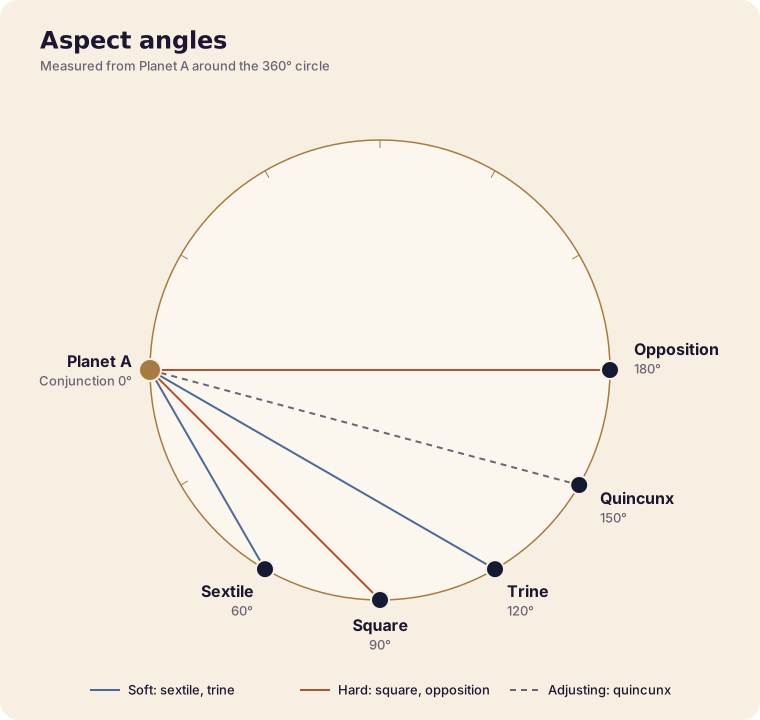
Aspects are the angles between planets in a birth chart. When two planets sit a meaningful distance apart around the zodiac, such as 90° or 120°, astrologers say they form an aspect, and that angle describes how the two parts of you get along. The five major aspects are the conjunction (0°), sextile (60°), square (90°), trine (120°), and opposition (180°). The quincunx (150°) is the most widely used extra.
Here is the short version you can quote: planets and signs tell you what and how, houses tell you where, and aspects tell you how the pieces of your chart talk to each other. A trine is an easy conversation, a square is an argument that gets things done, and a conjunction is two voices speaking at once.
Aspects at a glance
| Aspect | Angle | Signs apart | Typical orb | Traditional tone |
|---|---|---|---|---|
| Conjunction | 0° | Same sign | 6–8° | Blending, intensifying |
| Sextile | 60° | Two | 4–6° | Opportunity, cooperation |
| Square | 90° | Three | 6–7° | Friction, drive, challenge |
| Trine | 120° | Four | 6–7° | Ease, flow, talent |
| Quincunx | 150° | Five | 2–3° | Adjustment, awkwardness |
| Opposition | 180° | Six | 6–8° | Tension, balance, awareness |
Our birth chart calculator uses orbs of 8° for conjunctions and oppositions, 7° for squares and trines, and 5° for sextiles, and lists the five major aspects under your chart.
How aspects are measured
The zodiac is a 360° circle. Every planet has a position on it, such as 14° Taurus. To find the aspect between two planets, measure the shorter distance between them around the circle and compare it with the aspect angles. Two planets 118° apart are within 2° of a trine, so they form a trine with a 2° orb.
Because each sign is 30° wide, the major aspects line up with whole-sign relationships:
- Conjunctions usually fall in the same sign.
- Sextiles link signs two apart, which are always fire with air or earth with water.
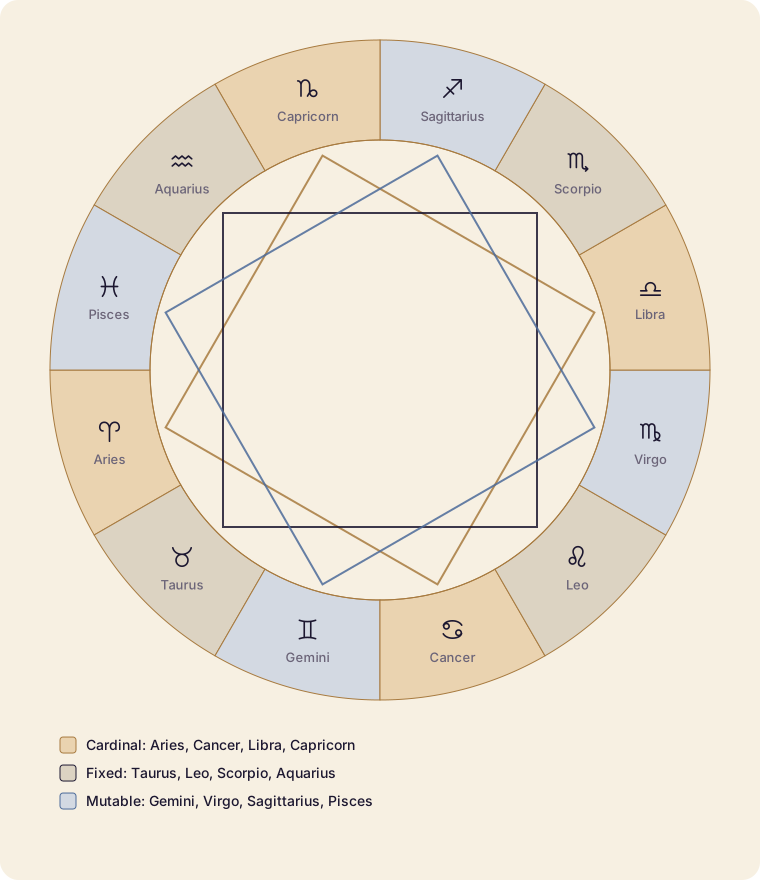
- Squares link signs three apart, which always share a modality (cardinal, fixed, or mutable).
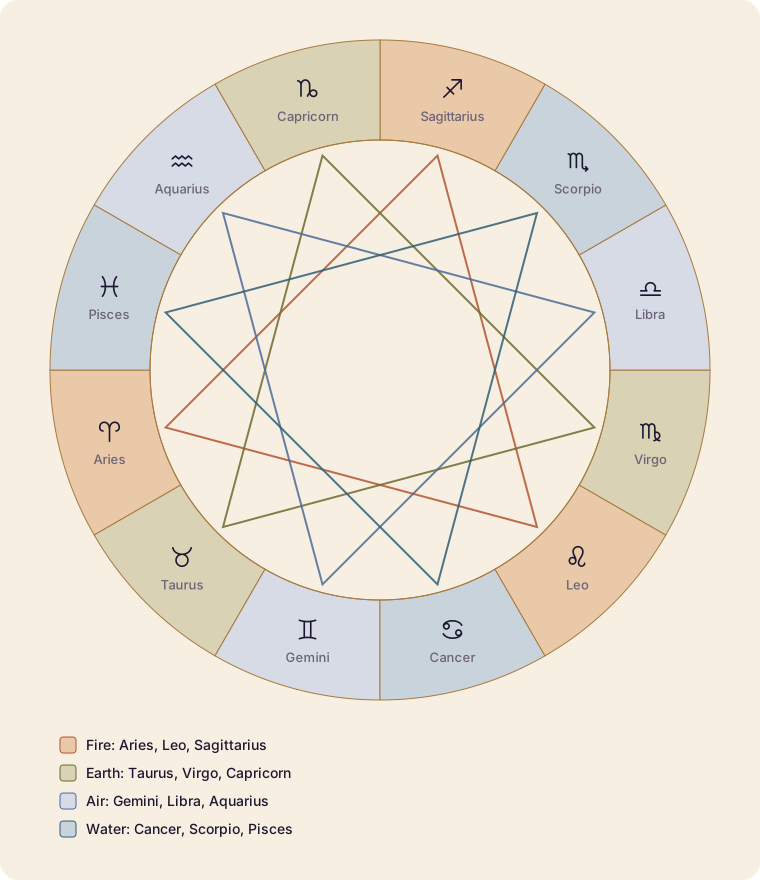
- Trines link signs four apart, which always share an element.
- Oppositions link signs six apart, which share a modality and sit on the same axis.
- Quincunxes link signs five apart, which share nothing.
That is why aspects connect so naturally with the four elements and cardinal, fixed, and mutable modalities.
The conjunction (0°)
Two planets in the same place merge their themes. Neither works alone: a conjunction of the Sun and Mercury ties identity to thinking, and one of Venus and Mars blends affection with desire. The conjunction is neither soft nor hard on its own. It takes on the character of the planets involved, so Venus with Jupiter is usually read as generous, while Mars with Saturn is read as disciplined or frustrated depending on the rest of the chart.
A conjunction is the most powerful aspect, and a cluster of three or more planets in one sign, called a stellium, makes that sign a major theme of the whole chart.
The sextile (60°)
A sextile links signs of compatible elements, fire with air or earth with water. Tradition calls it an aspect of opportunity: the planets cooperate, but you usually have to take the first step. Think of a friendly introduction rather than a guaranteed result. A sextile between Mercury and Mars, for example, often describes someone who can turn an idea into action once they decide to.
A slow example from the current sky: Uranus and Neptune form an exact sextile on January 15, 2027, at about 2° Gemini and 2° Aries. It is covered in January 2027 astrology.
The square (90°)
A square links signs of the same modality but clashing elements, such as Leo (fire) and Scorpio (water). The planets want different things and are both trying to act, so the square creates pressure. It is the aspect of effort: many accomplished people have prominent squares, because friction pushes them to build skill.
In the sky, the Sun at about 27° Scorpio squares Mars at about 27° Leo on November 19, 2026. Both are fixed signs, which is why the square is often read as a stubborn standoff between will (Mars) and identity (the Sun). See November 2026 astrology for the month's context.
The trine (120°)
A trine links signs of the same element, such as Virgo and Capricorn. The planets understand each other, so energy flows easily between them. Trines describe natural talent, comfort, and luck. The risk is that easy gifts can go unused, because nothing forces you to develop them.
In the sky, the Sun at about 10° Capricorn trines Mars at about 10° Virgo on December 31, 2026, an earth trine that tradition reads as steady, practical effort. December 2026 astrology covers the rest of that month.
The opposition (180°)
An opposition links signs directly across the zodiac, such as Aries and Libra or Taurus and Scorpio. Opposite signs share a modality and a theme seen from two sides: self and partner, security and transformation. The opposition is read as a seesaw. It often shows up in relationships, because people tend to meet the other end of the axis in someone else. The work is balance, not victory.
The quincunx (150°)
The quincunx, or inconjunct, links signs that share neither element nor modality, such as Aries and Virgo. There is no common language between them, so the planets need constant small adjustments, like two people who keep missing each other's point. In the sky, Mars at about 2° Virgo forms a quincunx to Neptune at about 2° Aries on November 30, 2026.
Because it is subtle, most astrologers use a small orb of 2° to 3° for the quincunx. Two quincunxes to the same planet, joined by a sextile, form the pattern called a yod.
Orbs: how close is close enough
An exact aspect rarely happens in a birth chart, so astrologers allow an orb. Common practice:
- Wider orbs (up to 8° to 10°) when the Sun or Moon is involved, because they are the chart's most important points.
- 6° to 8° for conjunctions, squares, trines, and oppositions between planets.
- 4° to 6° for sextiles.
- 2° to 3° for the quincunx and minor aspects such as the semi-square (45°) and sesquiquadrate (135°).
The tighter the orb, the stronger the aspect. An aspect within 1° is felt as a core part of the personality. One at the edge of its orb is a background theme.
Two more terms are worth knowing. An applying aspect is one where the faster planet is still moving toward the exact angle, read as building. A separating aspect is past exact, read as fading or already integrated. And an out-of-sign aspect is one that works by degree but not by sign: 29° Aries and 1° Leo are 92° apart, a square, even though Aries and Leo are normally trine signs.
How to read aspects in your chart
- Get your chart. Use the birth chart calculator with your birth time if you can. The Moon moves about 13° a day, so its aspects need an accurate time, and so do aspects to your rising sign.
- Start with the tightest aspects. Sort by orb. Anything within 2° deserves your attention first.
- Name the two planets. Each planet is a function: the Moon is needs, Mercury is thinking, Venus is love, Mars is drive, Saturn is structure.
- Add the aspect as the verb. A conjunction blends them, a trine supports, a sextile offers, a square challenges, an opposition balances, a quincunx adjusts.
- Add the signs and houses. The signs color how each planet acts and the houses show where in life the aspect plays out. See the 12 houses explained.
- Look for repeats. If three different aspects all say "tension between freedom and security," that is a main theme.
A worked example: imagine the Moon at 15° Cancer and Mars at 12° Aries. They are 93° apart, a square with a 3° orb. The Moon (emotional needs) in Cancer (security, family) squares Mars (drive, anger) in Aries (independence, speed). A plain reading: this person may feel torn between needing closeness and needing to act alone, and may react fast when feelings are hurt. The growth path is learning to pause between feeling and acting. Notice that the reading came from combining two planets, one verb, and two signs. That is the whole method.
For the bigger picture of placements, signs, and houses, read how to read your birth chart and what is a rising sign.
Aspect patterns
When several aspects connect, they form shapes that astrologers read as a whole:
- Grand trine: three planets each about 120° apart, usually in one element. A strong, self-contained talent.
- T-square: two planets in opposition, both square a third. A driving tension focused on the third planet.
- Grand cross: four planets in two oppositions and four squares. Rare, demanding, and energetic.
- Yod: two planets in sextile, both quincunx a third. Often read as a sense of a specific calling.
- Stellium: three or more planets conjunct in one sign or house.
Aspects in the current sky
Aspects are not only in your birth chart. Planets moving today form aspects to each other and to your natal planets, which astrologers call transits. That is the basis of most horoscopes, including the monthly horoscope for Scorpio and the other signs. Our monthly sky guides for November 2026, December 2026, and January 2027 list the major transiting aspects with computed dates, and the free 2027 forecast covers the year ahead.
Common misconceptions about aspects
"Squares and oppositions are bad." They describe effort and tension, which many astrologers see in the charts of high achievers. A chart made of nothing but trines can describe someone who coasts.
"More aspects is better." Every chart has many aspects. What matters is which ones are tight and which planets they involve.
"An aspect only counts if it is exact." Orbs exist because the angle is a range of influence, strongest at exact and fading toward the edges.
"Aspects only matter between signs." Aspects are measured in degrees. Out-of-sign aspects still count.
The takeaway
Aspects are the grammar of astrology. Planets are the nouns, signs the adjectives, houses the settings, and aspects the verbs that connect them. Learn the six angles, use sensible orbs, start with the tightest aspects in your chart, and you can read almost any combination in plain language.
Frequently asked questions
What are aspects in astrology?
Aspects are specific angles between two planets or points in a chart, measured along the zodiac. The major aspects are the conjunction (0 degrees), sextile (60), square (90), trine (120), and opposition (180). Each angle describes how the two planets work together: blending, cooperating, clashing, or pulling in opposite directions.
What is an orb in astrology?
An orb is the allowance around an exact aspect. Two planets 87 degrees apart are 3 degrees from an exact square, so they form a square with a 3 degree orb. Most astrologers allow about 6 to 8 degrees for conjunctions, squares, trines, and oppositions, about 4 to 6 for sextiles, and 2 to 3 for the quincunx. The tighter the orb, the stronger the aspect.
Which aspects are good and which are bad?
Tradition calls trines and sextiles soft or harmonious and squares and oppositions hard or challenging, with conjunctions depending on the planets involved. Modern astrologers avoid good and bad: soft aspects describe ease and talent, while hard aspects describe friction that often produces effort, achievement, and growth.
What is a quincunx?
A quincunx, also called an inconjunct, is a 150 degree angle between planets in signs that share neither element nor modality, such as Aries and Virgo. It is read as an awkward link that requires constant adjustment. Many astrologers use a small orb of 2 to 3 degrees.
How do I find the aspects in my birth chart?
Enter your birth date, time, and place into a birth chart calculator. Our calculator lists the major aspects between your planets, with the orb for each. Start with the tightest aspects and any that involve your Sun, Moon, or rising sign.
What is an out-of-sign aspect?
An out-of-sign or dissociate aspect is one that falls within orb by degree but not by sign. For example, 29 degrees Aries and 1 degree Leo are 92 degrees apart, a square by degree, even though Aries and Leo are normally trine signs. Most astrologers still count it, often as a slightly blended or less obvious version of the aspect.
Check it in your own chart
Related guides
Astrology foundations
How to read your birth chart: a step-by-step guide for beginners
A birth chart is a map of the sky at your birth. Read it in four layers: planets, signs, houses, and aspects. This guide walks you through each step with a worked example.
6 min read
Astrology foundations
The 12 houses in astrology explained
The twelve houses divide your birth chart into areas of life, from self and money to career and the unconscious. Here is what each house covers and how to read planets in it.
6 min read
Astrology foundations
What is a Mars sign? Drive, anger, and how you go after what you want
Your Mars sign is the zodiac sign Mars occupied when you were born. It describes your drive, your courage, how you handle anger and conflict, and how you pursue what you want. Unlike Mercury and Venus, it can be any sign. Here is what each Mars sign means.
9 min read
Astrology foundations
Cardinal, fixed, and mutable signs: the three modalities explained
Modalities describe how each zodiac sign uses its energy. Cardinal signs start things, fixed signs sustain them, and mutable signs adapt. Here is what that means for you and your relationships.
6 min read