Practical and seasonal
January 2027 astrology: key dates, Mars retrograde, and moons
A Capricorn new moon on January 7, Venus into Sagittarius the same day, Mars stationing retrograde in Virgo on January 10, Mercury into Aquarius on January 13, Aquarius season from January 20, and a Leo full moon on January 22. All dates calculated, in US Central Time.
By 12 Zodiac Signs Editorial TeamUpdated 11 min read

In this guide
- January 2027 key dates at a glance
- Where are the planets at the start of January?
- Mercury meets the Sun: January 1
- New moon in Capricorn and Venus into Sagittarius: January 7
- Mars stations retrograde in Virgo: January 10
- Mercury enters Aquarius: January 13
- Uranus and Neptune: an exact sextile on January 15
- Aquarius season begins: January 20
- Full moon in Leo: January 22
- The Sun meets Pluto: January 25
- The slow planets this month
- January 2027 by sign: a quick guide
- How to use January 2027, week by week
- If you have a birthday this month
- Looking ahead to February 2027
- Common misconceptions about this month
- The takeaway
January 2027 opens in Capricorn season and turns to Aquarius on the 20th. The headline dates are a new moon at about 17° Capricorn on January 7, Venus entering Sagittarius that same morning, Mars stationing retrograde at about 10° Virgo on January 10, Mercury entering Aquarius on January 13, a rare exact sextile between Uranus and Neptune on January 15, Aquarius season beginning on January 20, a full moon at about 2° Leo on January 22, and the Sun meeting Pluto on January 25. There are no eclipses this month and Mercury is not retrograde. Every date and degree below was calculated with Astronomy Engine and is given in US Central Time.
As always, this is astrology as a tradition of meaning, not a forecast of events. Use it as a calendar for reflection. For the months that led here, see December 2026 astrology and November 2026 astrology.
January 2027 key dates at a glance
| Date (CT) | Event | Position |
|---|---|---|
| Jan 1, noon | Starting sky | Sun ~11.1° Capricorn, Moon ~4.0° Scorpio |
| Jan 1, ~11:08 a.m. | Mercury meets the Sun | ~11.1° Capricorn |
| Jan 7, ~2:53 a.m. | Venus enters Sagittarius | 0° Sagittarius |
| Jan 7, 2:25 p.m. | New moon | ~17.3° Capricorn |
| Jan 10, ~7:00 a.m. | Mars stations retrograde | ~10.4° Virgo |
| Jan 13, ~12:06 a.m. | Mercury enters Aquarius | 0° Aquarius |
| Jan 15, ~1:21 a.m. | Uranus sextile Neptune (exact) | ~1.9° Gemini and Aries |
| Jan 15, ~8:49 p.m. | Mercury meets Pluto | ~4.8° Aquarius |
| Jan 20, ~1:30 a.m. | Sun enters Aquarius | 0° Aquarius |
| Jan 22, 6:17 a.m. | Full moon | ~2.2° Leo |
| Jan 25, ~2:00 a.m. | Sun meets Pluto | ~5.1° Aquarius |
| Jan 31, ~7:26 p.m. | Mercury enters Pisces | 0° Pisces |
Where are the planets at the start of January?
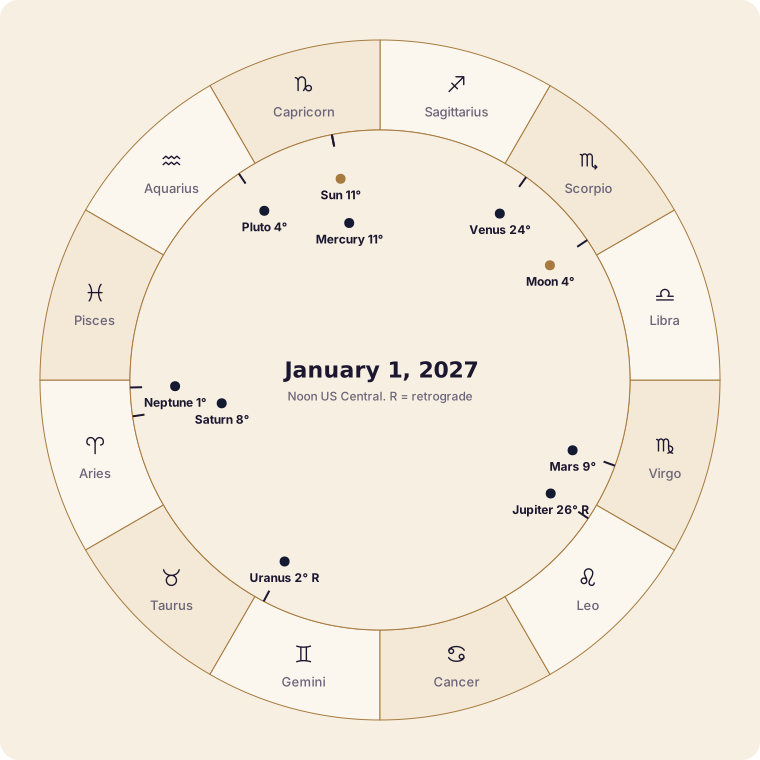
On January 1, 2027 at noon US Central:
- Sun in Capricorn, about 11.1°
- Moon in Scorpio, about 4.0°
- Mercury in Capricorn, about 11.1°
- Venus in Scorpio, about 24.2°
- Mars in Virgo, about 10.0°
- Jupiter retrograde in Leo, about 26.4°
- Saturn in Aries, about 8.4°
- Uranus retrograde in Gemini, about 2.3°
- Neptune in Aries, about 1.7°
- Pluto in Aquarius, about 4.4°
The year starts with the Sun and Mercury almost exactly together in Capricorn. Mars is slowing down in Virgo, less than half a degree from the point where it will turn around ten days later. Saturn and Neptune are both moving forward again in early Aries after their December stations, and Jupiter and Uranus are the two planets still in retrograde.
Mercury meets the Sun: January 1
Mercury lines up with the Sun at about 11:08 a.m. CT on January 1, at about 11° Capricorn. Because Mercury is on the far side of the Sun here (astronomers call it superior conjunction), this is the midpoint of Mercury's direct cycle, not a retrograde. Tradition reads it as a moment when thinking and purpose fuse: the plan you write on New Year's Day tends to sound a lot like who you want to be.
If you want to understand what your own Mercury sign says about how you think and talk, see what is a Mercury sign.
New moon in Capricorn and Venus into Sagittarius: January 7
Two things happen on January 7. First, Venus leaves Scorpio and enters Sagittarius at about 2:53 a.m. CT. After a month of Scorpio intensity, Venus in Sagittarius traditionally prefers honesty, humor, and room to roam. It stays there until February 3.
Then the new moon arrives at 2:25 p.m. CT, at about 17° Capricorn. New moons are traditionally times for setting intentions. In Capricorn, the themes are structure, ambition, responsibility, and the long game. This is arguably the most natural new moon of the year for resolutions, because Capricorn's preferred kind of resolution is a plan with steps rather than a wish.
Reflection prompts:
- What do I want to have built by the end of 2027, and what is the first brick?
- Which commitment have I been carrying out of guilt rather than choice?
- Where would a little more patience make the outcome better?
Mars stations retrograde in Virgo: January 10
Mars slows to a stop and turns retrograde at about 7:00 a.m. CT on January 10, at about 10.4° Virgo. This is the only Mars retrograde of 2027 and the first since early 2025. Mars will back up through Virgo, re-enter Leo on February 21, and station direct on April 1, 2027 at about 20.9° Leo. Station times for slow-moving planets are approximate, because the planet barely moves for several days on either side of the turn.
In tradition, Mars is drive, effort, anger, and courage. Retrograde Mars is read as a time to review how you spend energy rather than to start new fights or force new launches. In Virgo the review turns practical: health routines, workloads, tools, systems, and the small daily habits that either support you or quietly drain you.
Reflection prompts:
- Which routine am I running on autopilot that no longer works?
- Where am I working hard on the wrong thing?
- What would it look like to rest before I am forced to?
Signs that may feel it most: Virgo (Mars is in your sign), Pisces (across the axis), and Gemini and Sagittarius (the other mutable signs). Leo picks up the theme from late February. For a refresher on how retrogrades work in general, see what Mercury retrograde means; the mechanics are the same for Mars, only slower.
Mercury enters Aquarius: January 13
Mercury leaves Capricorn and enters Aquarius at about 12:06 a.m. CT on January 13. The mental tone traditionally shifts from practical and hierarchical to inventive and collective: networks, technology, unusual ideas, and conversations about the future. On January 15 at about 8:49 p.m. CT, Mercury meets Pluto at about 4.8° Aquarius, a contact tradition links to deep research, persuasive speech, and conversations that get to the root of something.
Mercury stays in Aquarius until January 31, when it enters Pisces. That move matters for February: Mercury will station retrograde in Pisces on February 9.
Uranus and Neptune: an exact sextile on January 15
At about 1:21 a.m. CT on January 15, Uranus (about 1.9° Gemini, retrograde) and Neptune (about 1.9° Aries) form an exact sextile, a 60° angle. This is a slow, generational contact: the two planets also reached the exact angle in August and November 2025 and in July 2026, and will once more in June 2027. Tradition associates Uranus with change and invention and Neptune with ideals and imagination, so a sextile between them is often read as a long window in which new ideas and new ideals cooperate.
You will not feel this one personally on the 15th unless it touches a planet or angle in your own chart near 0° to 3° of Gemini, Aries, Leo, Libra, Sagittarius, or Aquarius. Check your placements with the birth chart calculator.
Aquarius season begins: January 20
The Sun enters Aquarius at about 1:30 a.m. CT on January 20. Aquarius season is traditionally associated with friendship, community, independence, originality, and the future. Happy birthday, Aquarius. Capricorn season ends here: if early January was about building the plan, late January is about who you build it with.
The Sun also forms a trine to Uranus late on January 21 and a sextile to Neptune early on January 22, which many astrologers read as a lively, idea-rich opening week for the new season.
Full moon in Leo: January 22
The full moon falls at 6:17 a.m. CT on January 22, at about 2.2° Leo, opposite the Sun in early Aquarius. Full moons traditionally highlight culmination and awareness. The Leo–Aquarius axis is about the individual versus the group: personal joy, creativity, and visibility on one side, community, friendship, and shared causes on the other.
With Jupiter retrograde in late Leo, this full moon is a natural time to ask whether your creative life is growing in the direction you actually want, or only in the direction that gets applause.
Reflection prompts:
- Where do I want to be seen more, and where do I want to contribute more?
- What is ready to be finished, celebrated, or shared?
The Sun meets Pluto: January 25
The Sun reaches Pluto at about 2:00 a.m. CT on January 25, at about 5.1° Aquarius. This conjunction happens every year, but with Pluto now settled in Aquarius it lands in the first week of Aquarius season. Tradition reads contacts between the Sun and Pluto as a time for honest self-assessment about power: where you hold it, where you give it away, and what you are ready to let go of entirely.
The slow planets this month
- Jupiter retrograde in Leo (since December 12, 2026) continues until April 12, 2027. Mercury opposes it on January 27, a classic moment for big ideas that need a reality check.
- Saturn in Aries, moving forward again, receives a supportive trine from Venus on January 15 and a sextile from the Sun on January 30. Commitments made with courage tend to look sturdier this month.
- Uranus retrograde in Gemini stations direct on February 8, 2027 at about 1.7° Gemini.
- Neptune in Aries is direct and moving slowly through the first degrees of the sign.
- Pluto in Aquarius is direct, hosting both Mercury (January 15) and the Sun (January 25).
For the year that just ended, see 2026 retrogrades. For a sign-by-sign look at all of 2027, get the free 2027 forecast.
January 2027 by sign: a quick guide
| Your sign | A theme to reflect on |
|---|---|
| Aries | Career and reputation under the Capricorn new moon; Saturn and Neptune in your sign |
| Taurus | Learning and travel plans; Mars retrograde reviews your creative and romantic life |
| Gemini | Shared money and deep bonds; Uranus nears its station in your sign |
| Cancer | Partnerships take focus at the new moon; communication rhythms need review |
| Leo | The full moon in your sign and Jupiter retrograde: what you are ready to show |
| Virgo | Mars stations retrograde in your sign: rest, review, and repair before you push |
| Libra | Home and family plans; Venus in Sagittarius lightens conversations |
| Scorpio | Daily communication and short trips; Venus leaves your sign on the 7th |
| Sagittarius | Venus arrives in your sign: warmth, attraction, and a clearer sense of value |
| Capricorn | The new moon in your sign on the 7th: the cleanest restart of the year |
| Aquarius | Your season starts on the 20th, with Mercury and Pluto already in your sign |
| Pisces | Friends and future plans; Mars retrograde in your opposite sign asks for patience in partnership |
These themes use whole-sign solar houses from your sun sign. If you know your rising sign, read the table again for that sign too, since many astrologers use the rising sign for house timing. Not sure of yours? See what is a rising sign. For the full month written for your sign, read the monthly horoscopes for Capricorn, Aquarius, Virgo, Leo, or any sign from the horoscope hub.
How to use January 2027, week by week
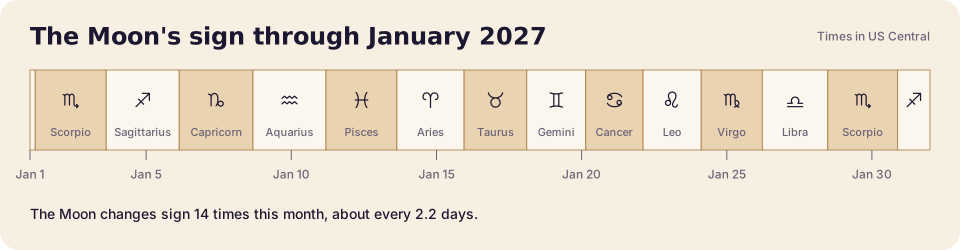
- January 1–7: Sun and Mercury together in Capricorn, then the Capricorn new moon and Venus into Sagittarius on the 7th. Write the plan, then pick one first step.
- January 8–14: Mars stations retrograde on the 10th and Mercury enters Aquarius on the 13th. Slow down physical and work commitments; let ideas run ahead while effort catches up.
- January 15–21: The Uranus and Neptune sextile and Mercury meeting Pluto on the 15th, then Aquarius season on the 20th. Good for research, honest conversations, and joining groups that share your direction.
- January 22–31: The Leo full moon on the 22nd, the Sun meeting Pluto on the 25th, and Mercury into Pisces on the 31st. Celebrate what is finished, release what is not working, and start backing up files before February's Mercury retrograde.
If you have a birthday this month
Capricorn birthdays (through January 19): your solar return comes with a new moon in your sign on the 7th, which tradition reads as an unusually clean personal reset. Mars retrograde in fellow earth sign Virgo favors refining plans over rushing them.
Aquarius birthdays (from January 20): your season opens with Mercury and Pluto already in your sign and the Sun meeting Pluto on the 25th. Many astrologers read that as a birthday about personal power and honest reinvention. If your Sun and Mercury share a sign, the Mercury sign guide explains why that matters.
Looking ahead to February 2027
February brings the year's first eclipse season. An annular solar eclipse at about 17.6° Aquarius peaks at 9:59 a.m. CT on February 6, with greatest eclipse over the South Atlantic, and a penumbral lunar eclipse at about 2° Virgo peaks at 5:12 p.m. CT on February 20. Mercury stations retrograde on February 9 at about 6° Pisces and turns direct on March 3 at about 21° Aquarius. Uranus stations direct on February 8, and Mars backs into Leo on February 21. Late January is a good time to finish loose ends before that busier stretch.
Common misconceptions about this month
"Mars retrograde means I should not start anything until April." Tradition advises care, not paralysis. It is a better time to revise, repair, and train than to pick fights or launch with no plan, but ordinary life goes on.
"January has eclipses." It does not. The eclipse pair falls in February, starting with the solar eclipse on February 6.
"Aquarius season is cold and detached." Aquarius themes include friendship, loyalty to ideals, and care for the group. It is warm toward people in a different way than Leo or Cancer.
The takeaway
January 2027 is a month for building with patience. The Capricorn new moon on the 7th gives the cleanest start of the year, Mars retrograde from the 10th asks you to review how you spend energy rather than force it, and Aquarius season from the 20th widens the circle. Make the plan early in the month, pace the effort through the middle, and use the Leo full moon on the 22nd to notice what is already working.
Frequently asked questions
When is the new moon in January 2027?
The new moon is on January 7, 2027 at 2:25 p.m. US Central Time, at about 17 degrees Capricorn.
When is the full moon in January 2027?
The full moon is on January 22, 2027 at 6:17 a.m. US Central Time, at about 2.2 degrees Leo.
When does Mars go retrograde in 2027?
Mars stations retrograde on January 10, 2027 at about 7:00 a.m. US Central Time, at about 10.4 degrees Virgo. It backs into Leo on February 21 and stations direct on April 1, 2027 at about 20.9 degrees Leo.
When does Aquarius season start in 2027?
The Sun enters Aquarius on January 20, 2027 at about 1:30 a.m. US Central Time. Aquarius season runs until the Sun enters Pisces on February 18, 2027.
Is there an eclipse in January 2027?
No. January 2027 has no eclipses. The next ones are an annular solar eclipse on February 6, 2027, at about 17.6 degrees Aquarius, and a penumbral lunar eclipse on February 20, 2027, at about 2 degrees Virgo.
Is Mercury retrograde in January 2027?
No. Mercury is direct all month. Its first retrograde of 2027 begins on February 9 at about 6 degrees Pisces and ends on March 3 at about 21 degrees Aquarius.
Check it in your own chart
Related guides
Practical and seasonal
December 2026 astrology: key dates, Capricorn season, and moons
Venus enters Scorpio on December 4, a Sagittarius new moon on December 8, Saturn and Neptune station direct mid-month, Capricorn season from December 21, and a Cancer full moon on December 23. All dates calculated, in US Central Time.
8 min read
Practical and seasonal
November 2026 astrology: key dates, retrogrades, and moons
Mercury and Venus both station direct on November 13, 2026, a new moon in Scorpio on November 9, Sagittarius season from November 22, and a Gemini full moon on November 24. All dates calculated, in US Central Time.
6 min read
Astrology foundations
What is a Mercury sign? How you think, talk, and learn
Your Mercury sign is the zodiac sign Mercury occupied when you were born. It describes how you think, speak, learn, and make decisions. It is always your sun sign or one of the two signs beside it. Here is what each Mercury sign means.
9 min read
Astrology foundations
What is Mercury retrograde? Meaning, dates, and what to actually do
Mercury retrograde is the period, about three times a year, when Mercury appears to move backward from Earth's view. Here is the astronomy, the astrological meaning, and the 2026 dates.
6 min read