Practical and seasonal
February 2027 astrology: eclipse season, Mercury retrograde, and Pisces season
An annular solar eclipse in Aquarius on February 6, Mercury retrograde from February 9 to March 3, Uranus stationing direct on February 8, Pisces season from February 18, and a penumbral lunar eclipse in Virgo on February 20. All dates calculated, in US Central Time.
By 12 Zodiac Signs Editorial TeamUpdated 14 min read

In this guide
- February 2027 key dates at a glance
- Where are the planets at the start of February?
- Venus enters Capricorn: February 3
- Annular solar eclipse in Aquarius: February 6
- Uranus stations direct: February 8
- Mercury stations retrograde in Pisces: February 9
- Pisces season begins: February 18
- Penumbral lunar eclipse in Virgo: February 20
- Mars re-enters Leo: February 21
- The slow planets this month
- February 2027 by sign: a quick guide
- How to use February 2027, week by week
- If you have a birthday this month
- Looking ahead to March 2027
- Common misconceptions about this month
- The takeaway
February 2027 is the year's first eclipse season, and it arrives on top of a Mercury retrograde and a change of season. The headline dates are an annular solar eclipse at about 17.6° Aquarius at 9:59 a.m. CT on February 6, Uranus stationing direct at about 1.7° Gemini on February 8, Mercury stationing retrograde at about 6.0° Pisces at 11:35 a.m. CT on February 9, Pisces season beginning at 3:33 p.m. CT on February 18, and a penumbral lunar eclipse at about 2.0° Virgo at 5:12 p.m. CT on February 20. Mars, retrograde since January, backs from Virgo into Leo on February 21. Every date and degree below was calculated with Astronomy Engine and is given in US Central Time (CST all month).
As always, this is astrology as a tradition of meaning, not a forecast of events. Use it as a calendar for reflection. For the month that led here, see January 2027 astrology. For the wider season, see December 2026 astrology and November 2026 astrology.
February 2027 key dates at a glance
| Date (CT) | Event | Position |
|---|---|---|
| Feb 1, noon | Starting sky | Sun ~12.6° Aquarius, Moon ~19.4° Sagittarius |
| Feb 2, ~6:18 a.m. | Mercury square Uranus | ~1.7° Pisces and Gemini |
| Feb 3, ~8:30 a.m. | Venus enters Capricorn | 0° Capricorn |
| Feb 5, ~11:38 a.m. | Venus square Neptune | ~2.4° Capricorn and Aries |
| Feb 6, 9:59 a.m. | Annular solar eclipse (new moon) | ~17.6° Aquarius |
| Feb 7, ~8:29 p.m. | Venus trine Mars | ~5.2° Capricorn and Virgo (Mars Rx) |
| Feb 8, ~6:23 a.m. | Uranus stations direct | ~1.7° Gemini |
| Feb 9, 11:35 a.m. | Mercury stations retrograde | ~6.0° Pisces |
| Feb 13, ~5:36 a.m. | Venus square Saturn | ~11.4° Capricorn and Aries |
| Feb 14, 1:58 a.m. | First quarter moon | ~25.4° Taurus |
| Feb 16, ~4:39 p.m. | Mercury (Rx) square Uranus | ~1.7° Pisces and Gemini |
| Feb 17, ~12:36 a.m. | Mars (Rx) square Uranus | ~1.7° Virgo and Gemini |
| Feb 18, ~6:17 a.m. | Mercury re-enters Aquarius | 0° Aquarius, retrograde |
| Feb 18, ~10:39 a.m. | Sun meets Mercury (inferior conjunction) | ~29.8° Aquarius |
| Feb 18, 3:33 p.m. | Sun enters Pisces | 0° Pisces |
| Feb 20, ~9:10 a.m. | Sun square Uranus | ~1.7° Pisces and Gemini |
| Feb 20, 5:12 p.m. | Penumbral lunar eclipse (full moon 5:23 p.m.) | Moon ~2.0° Virgo |
| Feb 21, ~8:15 a.m. | Mars re-enters Leo | 0° Leo, retrograde |
| Feb 27, 11:16 p.m. | Last quarter moon | ~9.4° Sagittarius |
Where are the planets at the start of February?
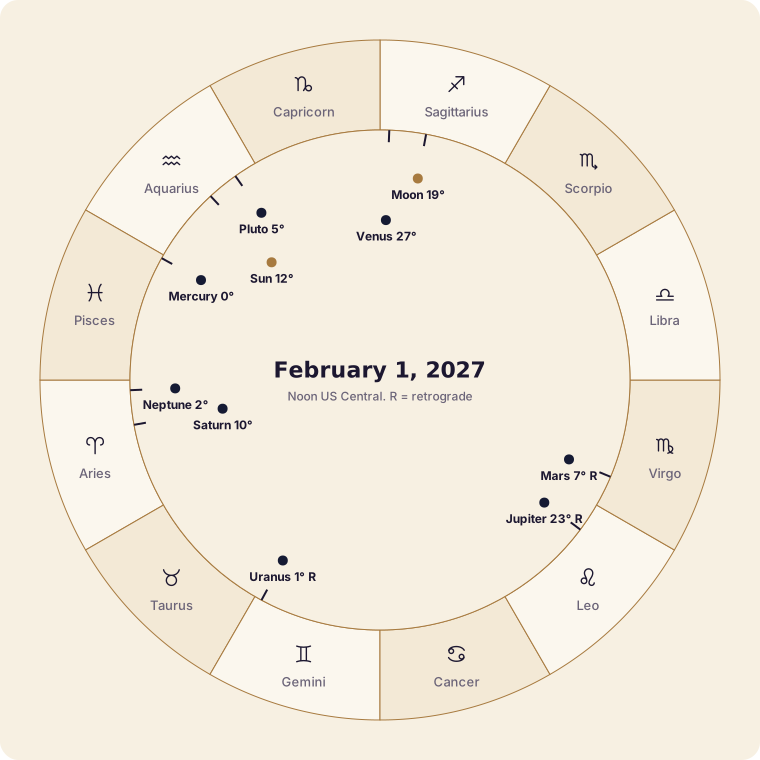
On February 1, 2027 at noon US Central:
- Sun in Aquarius, about 12.6°
- Moon in Sagittarius, about 19.4°
- Mercury in Pisces, about 0.8°
- Venus in Sagittarius, about 27.9°
- Mars retrograde in Virgo, about 7.2°
- Jupiter retrograde in Leo, about 23.3°
- Saturn in Aries, about 10.3°
- Uranus retrograde in Gemini, about 1.7°
- Neptune in Aries, about 2.3°
- Pluto in Aquarius, about 5.3°
The month opens in the heart of Aquarius season, with Mercury already in the first degree of Pisces and Venus in the last degrees of Sagittarius. Mars is backing through Virgo, Uranus is days from turning direct, and the Sun is moving toward the mid-Aquarius degree that will host the solar eclipse on the 6th.
Venus enters Capricorn: February 3
Venus leaves Sagittarius and enters Capricorn at about 8:30 a.m. CT on February 3. After a month of Sagittarian warmth and range, Venus in Capricorn traditionally prefers loyalty, patience, and results you can point to. It stays there until March 1, when it enters Aquarius.
Two early squares give the transit a serious tone. On February 5 at about 11:38 a.m. CT, Venus squares Neptune at about 2.4° Capricorn and Aries: a contact tradition links to rose-colored hopes that need a second look, especially around money, affection, and promises. On February 13 at about 5:36 a.m. CT, Venus squares Saturn at about 11.4° Capricorn and Aries, a cooler, more exacting angle that favors honest terms over grand gestures. Between them, on February 7 at about 8:29 p.m. CT, Venus trines retrograde Mars at about 5.2° Capricorn and Virgo, a supportive earth contact that can help a practical plan move even while Mars is in review.
If you want a refresher on how Venus colors love, money, and taste in a natal chart, see what is a Venus sign.
Annular solar eclipse in Aquarius: February 6
The new moon is also an annular solar eclipse, peaking at 9:59 a.m. CT on February 6, with the Sun and Moon at about 17.6° Aquarius. An annular eclipse happens when the Moon is a little too far from Earth to cover the Sun completely, leaving a ring of sunlight around a dark disk. Greatest eclipse falls over the South Atlantic, near 31° south, 48° west, off the coast of South America. A deep partial is visible from much of South America (including São Paulo, Rio de Janeiro, Buenos Aires, and Montevideo) and from parts of West Africa. It is not visible from the United States.
In astrology, a solar eclipse is traditionally a concentrated new moon: a reset with a longer echo than an ordinary lunation, often felt most clearly in the weeks around the date, and more personally if it lands near a planet or angle in your own chart, especially near 15° to 20° of Aquarius, Leo, Taurus, or Scorpio. In Aquarius the themes are community, friendship, future plans, technology, and the groups you belong to. The usual new-moon advice still holds, only more so: start what you can stand behind a year from now, not only what looks exciting this week.
Reflection prompts:
- Which community or collaboration actually fits the life I am building?
- What future am I planning for, and whose future is it?
- What would I start if I knew the results would be visible?
Check close contacts with the birth chart calculator. For a sign-by-sign year view, see the free 2027 forecast.
Uranus stations direct: February 8
Uranus, retrograde in Gemini since 2026, stations direct at about 6:23 a.m. CT on February 8, at about 1.7° Gemini. Station times for a slow planet are approximate, because it barely moves for several days on either side of the turn. Uranus has been in Gemini's first degrees through this retrograde, and it will spend years in the sign.
Tradition associates Uranus with disruption, invention, and a sudden change of mind. A direct station is often read as a release: ideas, conversations, and plans that have been stalled can start to move. Because the station is in early Gemini, and because Mercury, Mars, and the Sun all form squares to Uranus this month (February 2, 16, 17, and 20), the weeks around the 8th favor flexibility over rigid schedules. Gemini and the other mutable signs (Virgo, Sagittarius, and Pisces) may feel the station most clearly.
Mercury stations retrograde in Pisces: February 9
Mercury slows to a stop and turns retrograde at 11:35 a.m. CT on February 9, at about 6.0° Pisces. This is the first Mercury retrograde of 2027. Mercury will back through early Pisces, re-enter Aquarius at about 6:17 a.m. CT on February 18, and station direct on March 3 at 6:34 a.m. Central Time, at about 20.9° Aquarius.
In tradition, Mercury retrograde is a time to review, revise, and reopen, not a reason to halt ordinary life. In Pisces the review is less about spreadsheets and more about meaning: mixed messages, intuition that needs a fact check, creative work that wants another draft, and conversations that are kinder when you slow down. Once Mercury re-enters Aquarius, the tone shifts toward networks, plans, and the ideas you already sketched in late January, when Mercury was last in that sign (January 13 to 31).
The midpoint of the retrograde is the inferior conjunction, when Mercury passes between Earth and the Sun. That meeting falls at about 10:39 a.m. CT on February 18, at about 29.8° Aquarius, a few hours before the Sun enters Pisces. Tradition reads this as a mental reset in the last degree of Aquarius: a good moment to name the idea you actually want to carry into the next season, then let the leftover noise go.
Practical notes are the usual ones: back up files before the 9th if you can, build extra time into travel and contracts, and treat first drafts as first drafts. For a fuller explanation of the cycle, see what Mercury retrograde means and what is a Mercury sign.
Reflection prompts:
- Which conversation needs to be had a second time, more clearly?
- What did I decide too quickly in late January that deserves a second look?
- Where am I filling in a story that I have not actually been told?
Pisces season begins: February 18
The Sun enters Pisces at 3:33 p.m. CT on February 18. That is a busy day: Mercury has already slipped back into Aquarius that morning, the Sun and Mercury meet at late Aquarius late in the morning, and by mid-afternoon Aquarius season is over. Happy birthday, Pisces.
Pisces season is traditionally associated with imagination, compassion, rest, endings, and the close of the astrological year, which begins again at the Aries equinox in March. After a month of Aquarian ideas and group plans, the invitation is to feel what those plans cost and what they are for. With Mercury retrograde and a lunar eclipse two days later, this is a season opener that favors reflection over a hard launch.
Penumbral lunar eclipse in Virgo: February 20
The full moon is also a penumbral lunar eclipse, peaking at 5:12 p.m. CT on February 20, with the Moon at about 2.0° Virgo and the Sun at about 2.1° Pisces. The exact Sun–Moon opposition in longitude is at 5:23 p.m. CT, at about 2.1° Virgo. A penumbral eclipse is the gentlest kind: the Moon passes through the Earth's outer shadow, and the shading is easy to miss if you are not looking for it.
Visibility is uneven. At mid-eclipse the Moon is already a few degrees up in the northeastern United States (for example New York and Boston) and still rising along much of the East Coast. In the Midwest it comes up shortly after the peak, so the later part of the shading may be visible after moonrise. Farther west, the Moon is still below the horizon at mid-eclipse. Europe and Africa have a much better view. The eclipse window runs roughly from 3:11 p.m. to 7:13 p.m. CT.
In astrology, a lunar eclipse is a concentrated full moon: culmination, recognition, and release, often with a longer echo than a typical full moon. The Virgo–Pisces axis is about craft and care on one side, faith and feeling on the other: the work you do, and the meaning you hope it holds. With Mars still retrograde in early Virgo at the eclipse (it leaves the sign the next morning), the sky leans toward reviewing effort, health routines, and the difference between being helpful and being worn out.
The Sun also squares Uranus at about 9:10 a.m. CT on February 20, at about 1.7° Pisces and Gemini, so the eclipse day carries a restless, last-minute-change quality. Build a little slack into the plan.
Reflection prompts:
- What have I been maintaining that no longer needs me?
- Where has useful work turned into overwork?
- What would it look like to finish something quietly, without a big announcement?
Signs that may feel the eclipse pair most: Aquarius and Leo for the solar eclipse, Virgo and Pisces for the lunar eclipse, plus anyone with planets or angles near 0° to 6° or 16° to 20° of the fixed or mutable signs. For the month written for your sign, start with the monthly horoscopes for Aquarius, Pisces, Virgo, or Leo, or any sign from the horoscope hub.
Mars re-enters Leo: February 21
Mars, retrograde since January 10 at about 10.4° Virgo, crosses back into Leo at about 8:15 a.m. CT on February 21. It will station direct on April 1 at 9:10 a.m. Central Time, at about 20.9° Leo, and will not return to Virgo until later in the spring.
In Leo the retrograde review turns from daily systems to pride, creativity, romance, and visibility: where you spend courage, and whether the fight is actually yours. The days just before the ingress are sharp. On February 16 at about 4:39 p.m. CT, retrograde Mercury squares Uranus, and in the small hours of February 17 at about 12:36 a.m. CT, retrograde Mars squares Uranus, both at about 1.7° of the mutable signs. Tradition reads that stretch as accident-prone and short-tempered if you rush. Slow down the machinery, and save the bold move for after Mars is direct in April.
For how Mars works in a birth chart, see what is a Mars sign.
The slow planets this month
- Jupiter retrograde in Leo continues until April 12, 2027, at which point it will station direct at about 17.0° Leo. It remains in Leo until late July.
- Saturn in Aries moves forward from about 10° toward the middle of the sign. It will station retrograde on August 9, 2027, still in Aries. For the natal meaning of this placement, see what is a Saturn sign.
- Uranus in Gemini is the planet that changes direction this month, turning direct on February 8.
- Neptune in Aries stays in the early degrees, not far from Saturn.
- Pluto in Aquarius is direct in the first decan, and the solar eclipse falls later in the same sign, about 12 degrees away.
For last year's retrograde calendar, see 2026 retrogrades. For a sign-by-sign look at all of 2027, get the free 2027 forecast.
February 2027 by sign: a quick guide
| Your sign | A theme to reflect on |
|---|---|
| Aries | Saturn and Neptune in your sign; the Aquarius eclipse reviews friendships and future plans |
| Taurus | Career and public role under the Aquarius solar eclipse; Venus in Capricorn favors steady work |
| Gemini | Uranus stations direct in your sign: let a new idea finish arriving before you announce it |
| Cancer | Shared resources and deep bonds; Pisces season opens a quieter, more private chapter |
| Leo | The Virgo lunar eclipse and Mars returning to your sign: pride, creativity, and a paced effort |
| Virgo | The lunar eclipse in your sign, then Mars finally leaves: release a routine that has run its course |
| Libra | Partnerships and collaboration; Mercury retrograde favors renegotiation over a brand-new deal |
| Scorpio | Daily work and health; the eclipse axis asks what is useful and what is only habit |
| Sagittarius | Venus leaves your sign on the 3rd; creative and romantic life wants more structure, less sprawl |
| Capricorn | Venus arrives in your sign: take attraction, money, and taste seriously, and define the terms |
| Aquarius | The solar eclipse in your sign on the 6th: a personal reset with a long echo |
| Pisces | Your season starts on the 18th, with Mercury beginning its retrograde in your sign on the 9th |
These themes use whole-sign solar houses from your sun sign. If you know your rising sign, read the table again for that sign too, since many astrologers use the rising sign for house timing. Not sure of yours? See what is a rising sign.
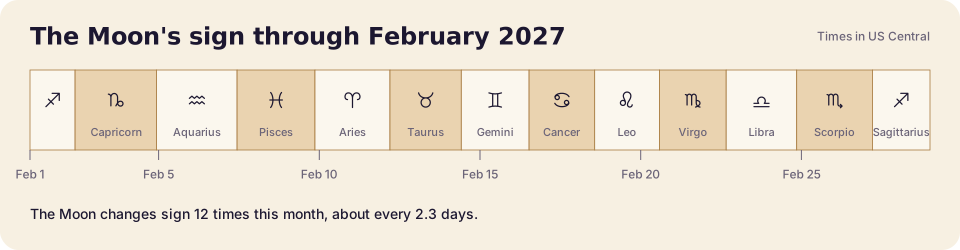
How to use February 2027, week by week
- February 1–6: Venus enters Capricorn on the 3rd, then the Aquarius solar eclipse on the 6th. Set one clear intention for the groups and plans you want to belong to, and finish loose ends before Mercury turns around.
- February 7–13: Uranus stations direct on the 8th and Mercury stations retrograde on the 9th. Expect revisions. The Venus–Mars trine on the 7th is a practical window; the Venus–Saturn square on the 13th is a time to be honest about cost and commitment.
- February 14–21: The first quarter moon on the 14th, Mercury and Mars squaring Uranus around the 16th and 17th, then Pisces season, the inferior conjunction, the Virgo lunar eclipse, and Mars into Leo. This is the busiest stretch of the month. Travel, tech, and tempers all benefit from extra margin.
- February 22–28: The sky quiets a little after the eclipse and the Mars ingress. Use the last week to edit, rest, and let Mercury finish its work in Aquarius. The last quarter moon on the 27th is a natural time to drop what the month already showed you does not belong.
If you have a birthday this month
Aquarius birthdays (through February 18): your solar return comes with a solar eclipse in your sign on the 6th, which tradition reads as a birthday year about identity, community, and a visible reset. Mercury will retrace late Aquarius from February 18 to March 3, so plans you make in the first half of the month may get a second draft.
Pisces birthdays (from February 18): your season opens two days before a lunar eclipse on the Virgo–Pisces axis, with Mercury retrograde already underway. Many astrologers read that as a birthday about release, imagination, and not rushing the first chapter. If your Sun and Mercury share a sign, the Mercury sign guide explains why that matters.
Looking ahead to March 2027
March begins with Venus entering Aquarius at about 12:32 a.m. CT on March 1. Mercury stations direct on March 3 at 6:34 a.m. Central Time, at about 20.9° Aquarius, and the next new moon is on March 8 at 3:29 a.m. Central Time, at about 17.6° Pisces. There is no eclipse in March. Mars remains retrograde in Leo until April 1, and Jupiter remains retrograde in Leo until April 12. The first half of March is for integrating what February's eclipses and the Mercury retrograde brought up, then moving again once Mercury is direct.
Common misconceptions about this month
"The solar eclipse will be visible across the United States." It will not. The annular path is over the South Atlantic, and the partial eclipse is a South American and West African event.
"A penumbral lunar eclipse is a dramatic blood moon." It is not. The shading is slight, and many people will not notice it unless they already know to look.
"Mercury retrograde means nothing will work until March." Tradition advises care, backups, and rereading the contract, not paralysis. Ordinary life goes on, and some of the best editing of the year happens now.
"Mars leaving Virgo ends the retrograde." Mars is still retrograde in Leo until April 1. The change of sign changes the subject, not the direction.
The takeaway
February 2027 is a month for resets that last. The Aquarius solar eclipse on the 6th is the cleanest moment to name the community and the future you want, Mercury retrograde from the 9th asks you to revise the plan before you announce it, and the Virgo lunar eclipse on the 20th shows what is ready to be finished or set down. Pisces season from the 18th closes the astrological year with feeling as well as thought. Make the intention early, leave room in the middle, and let the last week of the month be about integration rather than one more push.
Frequently asked questions
When is the solar eclipse in February 2027?
An annular solar eclipse peaks on February 6, 2027 at 9:59 a.m. US Central Time, at about 17.6 degrees Aquarius. Greatest eclipse is over the South Atlantic, off the coast of South America. It is not visible from the United States. Much of South America and parts of West Africa see a deep partial or, along a narrow path, the ring of fire.
When is the lunar eclipse in February 2027?
A penumbral lunar eclipse peaks on February 20, 2027 at 5:12 p.m. US Central Time, with the Moon at about 2.0 degrees Virgo, opposite the Sun in early Pisces. The exact full moon is a few minutes later, at 5:23 p.m. The shading is subtle. At mid-eclipse the Moon is already up in the northeastern United States and still rising along much of the East Coast.
When does Mercury go retrograde in February 2027?
Mercury stations retrograde on February 9, 2027 at 11:35 a.m. US Central Time, at about 6.0 degrees Pisces. It backs into Aquarius on February 18 and stations direct on March 3, 2027 at 6:34 a.m. Central Time, at about 20.9 degrees Aquarius.
When does Pisces season start in 2027?
The Sun enters Pisces on February 18, 2027 at 3:33 p.m. US Central Time. Pisces season runs until the Sun enters Aries at the March equinox.
Is the February 6, 2027 eclipse visible in the United States?
No. The annular path crosses the South Atlantic, and the partial eclipse is visible from much of South America and parts of West Africa. The continental United States is outside the visibility zone.
When does Mars leave Virgo in 2027?
Mars, already retrograde since January 10, re-enters Leo on February 21, 2027 at 8:15 a.m. US Central Time. It stations direct on April 1, 2027 at about 20.9 degrees Leo.
Check it in your own chart
Related guides
Practical and seasonal
January 2027 astrology: key dates, Mars retrograde, and moons
A Capricorn new moon on January 7, Venus into Sagittarius the same day, Mars stationing retrograde in Virgo on January 10, Mercury into Aquarius on January 13, Aquarius season from January 20, and a Leo full moon on January 22. All dates calculated, in US Central Time.
11 min read
Practical and seasonal
December 2026 astrology: key dates, Capricorn season, and moons
Venus enters Scorpio on December 4, a Sagittarius new moon on December 8, Saturn and Neptune station direct mid-month, Capricorn season from December 21, and a Cancer full moon on December 23. All dates calculated, in US Central Time.
8 min read
Astrology foundations
What is Mercury retrograde? Meaning, dates, and what to actually do
Mercury retrograde is the period, about three times a year, when Mercury appears to move backward from Earth's view. Here is the astronomy, the astrological meaning, and the 2026 dates.
6 min read
Astrology foundations
What is a Mercury sign? How you think, talk, and learn
Your Mercury sign is the zodiac sign Mercury occupied when you were born. It describes how you think, speak, learn, and make decisions. It is always your sun sign or one of the two signs beside it. Here is what each Mercury sign means.
9 min read