Practical and seasonal
Eclipses 2027: dates, signs, and where to see the August 2 total solar eclipse
All five eclipses of 2027: an annular solar eclipse in Aquarius on February 6, penumbral lunar eclipses on February 20, July 18, and August 17, and the long total solar eclipse in Leo on August 2. Times, degrees, and visibility calculated from the ephemeris, in US Central Time.
By 12 Zodiac Signs Editorial TeamUpdated 10 min read

In this guide
- Eclipses 2027 quick facts
- 2027 eclipse calendar
- Why eclipses come in seasons
- February 6, 2027: annular solar eclipse in Aquarius
- February 20, 2027: penumbral lunar eclipse in Virgo
- July 18, 2027: penumbral lunar eclipse in Capricorn
- August 2, 2027: total solar eclipse in Leo
- August 17, 2027: penumbral lunar eclipse in Aquarius
- Where the 2027 eclipses fall for your sign
- How to work with eclipse season
- How 2027 fits the bigger eclipse cycle
- Common misconceptions
- The takeaway
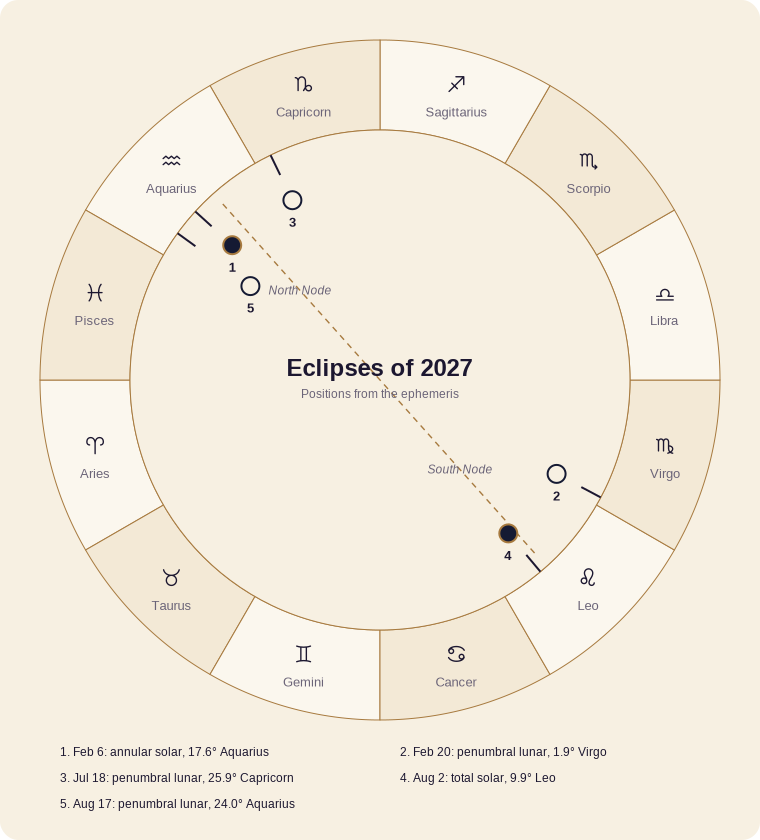
There are five eclipses in 2027: an annular solar eclipse at about 17.6° Aquarius on February 6, a penumbral lunar eclipse with the Moon at about 2.0° Virgo on February 20, a brief penumbral lunar eclipse at about 26.0° Capricorn on July 18, a long total solar eclipse at about 9.9° Leo on August 2, and a penumbral lunar eclipse at about 24.1° Aquarius on August 17. The lunar nodes sit in Aquarius and Leo all year, so the Leo–Aquarius axis is the year's main eclipse story. The headline event is August 2, when totality lasts more than six minutes along a path from southern Spain to Egypt and Arabia.
Every time, degree, and visibility detail below was calculated with Astronomy Engine, the ephemeris that runs this site, and times are in US Central Time (CST in February, CDT in July and August). This is astrology as a tradition of meaning, so read the interpretations as prompts for reflection rather than predictions. For safety, never look at the Sun without certified solar eclipse glasses, even during the partial phases.
Eclipses 2027 quick facts
- Number of eclipses: five, two solar and three lunar.
- February 6: annular solar eclipse, 9:59 a.m. CST, 17.6° Aquarius. Not visible from the US.
- February 20: penumbral lunar eclipse, 5:12 p.m. CST, Moon at 2.0° Virgo.
- July 18: penumbral lunar eclipse, 11:02 a.m. CDT, Moon at 26.0° Capricorn. Very shallow.
- August 2: total solar eclipse, 5:06 a.m. CDT, 9.9° Leo. Totality about 6 min 25 s at Luxor.
- August 17: penumbral lunar eclipse, 2:13 a.m. CDT, Moon at 24.1° Aquarius. Visible across the US.
- Lunar nodes: true North Node in Aquarius, South Node in Leo, all year (until March 26, 2028).
- Eclipse seasons: early February and mid-July to mid-August.
2027 eclipse calendar
| Date | Peak (CT) | Type | Position | Best seen from |
|---|---|---|---|---|
| Feb 6 | 9:59 a.m. CST | Annular solar | Sun and Moon ~17.6° Aquarius | South America, West Africa |
| Feb 20 | 5:12 p.m. CST | Penumbral lunar | Moon ~2.0° Virgo, Sun ~2.1° Pisces | Europe, Africa, Asia; moonrise in the eastern US |
| Jul 18 | 11:02 a.m. CDT | Penumbral lunar | Moon ~26.0° Capricorn, Sun ~25.8° Cancer | Asia, Australia, Pacific (US daytime) |
| Aug 2 | 5:06 a.m. CDT | Total solar | Sun and Moon ~9.9° Leo | Southern Spain, North Africa, Arabia |
| Aug 17 | 2:13 a.m. CDT | Penumbral lunar | Moon ~24.1° Aquarius, Sun ~24.2° Leo | The Americas, including all of the US |
Why eclipses come in seasons
An eclipse needs two things at once: a new moon or full moon, and the Moon sitting close to one of its nodes, the two points where its tilted orbit crosses the Sun's path. That alignment happens about every six months, so eclipses arrive in clusters called eclipse seasons, each lasting about five weeks. A new moon near a node becomes a solar eclipse, and a full moon near a node becomes a lunar eclipse.
Because the nodes slowly slide backward through the zodiac, eclipses stay in the same pair of opposite signs for about a year and a half. In 2027 the true North Node is in Aquarius and the South Node is in Leo, which is why three of the five eclipses fall in those two signs. Our guide to the North Node explains the nodes and what they mean in a birth chart.
February 6, 2027: annular solar eclipse in Aquarius
The year's first eclipse peaks at 9:59 a.m. CST on February 6, with the Sun and Moon together at about 17.6° Aquarius, close to the North Node. An annular eclipse happens when the Moon is a little too far from Earth to cover the Sun completely, so it leaves a bright ring of sunlight around its dark disk.
The path of annularity crosses southern Chile and Argentina (our calculation gives about 7 minutes 27 seconds of annularity at Esquel and almost 4 minutes at Bahía Blanca), runs out across the South Atlantic, and ends at sunset over West Africa, touching Côte d'Ivoire, Ghana, Togo, Benin, and Nigeria. Buenos Aires, Montevideo, Santiago, São Paulo, and Rio de Janeiro all see a deep partial eclipse. It is not visible from the United States.
In astrology, a solar eclipse is a supercharged new moon: a start, a door opening, or a sudden change of direction. In Aquarius, the themes are friendship, community, technology, independence, and the future you want to build with other people. It arrives just before Mercury stations retrograde on February 9, so the month is busy. See February 2027 astrology for the full picture.
February 20, 2027: penumbral lunar eclipse in Virgo
Two weeks later, the full moon slips through the Earth's outer shadow. The eclipse peaks at 5:12 p.m. CST, with the Moon at about 2.0° Virgo opposite the Sun at about 2.1° Pisces, and the penumbral phase runs from 3:11 to 7:13 p.m. CST. Penumbral eclipses only dim the Moon slightly, so the effect is subtle. In the eastern US the Moon rises during the eclipse, low in the east around sunset, while Europe, Africa, and Asia see it higher in the sky.
This eclipse falls on the Virgo–Pisces axis rather than Leo–Aquarius, a late echo of earlier eclipses there. Traditionally a lunar eclipse is a full moon with extra weight: a culmination, a release, or a truth surfacing. In Virgo, think health routines, daily work, and the small habits that make or break a larger dream.
July 18, 2027: penumbral lunar eclipse in Capricorn
The second eclipse season opens with the faintest eclipse of the year. It peaks at 11:02 a.m. CDT with the Moon at about 26.0° Capricorn and the Sun at about 25.8° Cancer, and the Moon only grazes the penumbra for roughly 25 minutes (10:50 to 11:15 a.m. CDT). It happens in US daytime, so it cannot be seen from North America, and even where the Moon is up it is almost impossible to notice. Astrologically it is still read as a full moon on the Cancer–Capricorn axis of home and career, with an eclipse's emphasis on endings and adjustments.
August 2, 2027: total solar eclipse in Leo
This is the eclipse people will travel for. Greatest eclipse is at 5:06 a.m. CDT (10:06 UTC), with the Sun and Moon at about 9.9° Leo, almost exactly conjunct the South Node. Because the Moon is close to Earth and the alignment is very tight, the shadow is wide and totality is unusually long.
The path of totality starts in the Atlantic, crosses the Strait of Gibraltar and the southern tip of Spain (our calculation gives about 4 min 29 s at Gibraltar, 2 min 53 s at Cádiz, and 1 min 51 s at Málaga), and covers northern Morocco (about 4 min 54 s at Tangier). It then runs across Algeria and Tunisia, through Libya (about 6 min 13 s at Benghazi), and into Egypt, where totality reaches about 6 minutes 25 seconds at Luxor. From there it crosses the Red Sea into Saudi Arabia (about 5 min 11 s at Mecca), Yemen, and Somalia. Madrid sees about 86 percent of the Sun covered, Cairo about 95 percent, and London about 42 percent. The eclipse is not visible from the United States.
Astrologically, a solar eclipse near the South Node is traditionally read as a release: something familiar finishing so that something new has room. In Leo, the themes are creativity, pride, visibility, romance, children, and the courage to be seen. Leo, Aquarius, Taurus, and Scorpio, the fixed signs, tend to feel the Leo–Aquarius eclipses most, especially if they have planets near 10° of their sign. Read your Leo monthly horoscope or Aquarius monthly horoscope around the date, and see what Leo is like as a sign on the Leo page.
August 17, 2027: penumbral lunar eclipse in Aquarius
The final eclipse of 2027 peaks at 2:13 a.m. CDT with the Moon at about 24.1° Aquarius and the Sun at about 24.2° Leo. The penumbral phase runs from 12:23 to 4:03 a.m. CDT, and the Moon is high in the sky across the whole continental US, so this is the most accessible eclipse of the year for American skywatchers, even if the shading is gentle. Look for a slightly dusky edge on one side of the Moon around 2 a.m.
In astrology, this full moon closes the Leo–Aquarius eclipse year on the Aquarius side: a moment to look at the communities, causes, and friendships you are part of, and to balance personal desire (Leo) against the needs of the group (Aquarius). Leo and Aquarius compatibility explores how those two energies meet in a relationship.
Where the 2027 eclipses fall for your sign
Using whole-sign solar houses (your sun sign counts as the first house), here is the area of life each eclipse lights up. The two Aquarius eclipses (February 6 and August 17) share a column. If you know your rising sign, read the table for it too, since rising-sign houses are often the better fit.
| Your sign | Aquarius (Feb 6, Aug 17) | Virgo (Feb 20) | Capricorn (Jul 18) | Leo (Aug 2) |
|---|---|---|---|---|
| Aries | 11th: friends, goals | 6th: work, health | 10th: career | 5th: romance, creativity |
| Taurus | 10th: career | 5th: romance, creativity | 9th: travel, beliefs | 4th: home |
| Gemini | 9th: travel, beliefs | 4th: home | 8th: shared money, intimacy | 3rd: communication |
| Cancer | 8th: shared money, intimacy | 3rd: communication | 7th: partnerships | 2nd: money |
| Leo | 7th: partnerships | 2nd: money | 6th: work, health | 1st: self |
| Virgo | 6th: work, health | 1st: self | 5th: romance, creativity | 12th: rest, the inner life |
| Libra | 5th: romance, creativity | 12th: rest, the inner life | 4th: home | 11th: friends, goals |
| Scorpio | 4th: home | 11th: friends, goals | 3rd: communication | 10th: career |
| Sagittarius | 3rd: communication | 10th: career | 2nd: money | 9th: travel, beliefs |
| Capricorn | 2nd: money | 9th: travel, beliefs | 1st: self | 8th: shared money, intimacy |
| Aquarius | 1st: self | 8th: shared money, intimacy | 12th: rest, the inner life | 7th: partnerships |
| Pisces | 12th: rest, the inner life | 7th: partnerships | 11th: friends, goals | 6th: work, health |
For what each house covers in more depth, see the 12 houses explained. For the most precise reading, find the exact house and degree in your own chart with the birth chart calculator.
How to work with eclipse season
- Expect speed. Eclipse seasons are traditionally associated with fast changes, so leave some slack in your calendar in early February and from mid-July to mid-August.
- Do not force a start on the day itself. Many astrologers suggest observing an eclipse rather than launching something on it, then acting in the weeks after, once the picture is clear.
- Notice what ends. Lunar eclipses are traditionally about completion. Something you are ready to finish may finish on its own.
- Check your degrees. An eclipse within a few degrees of your Sun, Moon, rising sign, or another personal planet is read as personally significant. Your moon sign and rising sign are good places to start.
- Plan the year as a whole. The free 2027 forecast maps eclipses, retrogrades, and transits against your own chart.
How 2027 fits the bigger eclipse cycle
The 2027 eclipses continue the Leo–Aquarius series that began with the eclipses of 2026, including the total solar eclipse of August 12, 2026, and they keep going into early 2028: a partial lunar eclipse on January 11, 2028 (10:13 p.m. CST, Moon at about 21.6° Cancer, visible from the US) and an annular solar eclipse on January 26, 2028 at about 6.2° Aquarius. The true North Node leaves Aquarius for Capricorn on March 26, 2028, which gradually moves the eclipses on to the Cancer–Capricorn axis. If you are reading month by month, the earlier sky is covered in November 2026 astrology, December 2026 astrology, and January 2027 astrology.
Common misconceptions
"Eclipses are bad omens." Older traditions feared them, but modern astrology reads eclipses as turning points, and many turn out to be welcome.
"You will feel every eclipse." Most people notice only the eclipses that touch a personal point in their chart. The rest pass quietly.
"Penumbral eclipses do not count." Astronomically they are subtle, but astrologers still treat them as eclipses, since the full moon is aligned with the nodes.
The takeaway
2027 has five eclipses, centered on the Leo–Aquarius axis, with one unforgettable sky event: the August 2 total solar eclipse in Leo, with more than six minutes of darkness in Egypt. Americans will need to travel for the solar eclipses, but the August 17 lunar eclipse is visible from home. Save the calendar, check the table for your sign, and pair it with the 2027 retrograde calendar to see the whole year at a glance.
Frequently asked questions
How many eclipses are there in 2027?
Five: an annular solar eclipse on February 6, a penumbral lunar eclipse on February 20, a penumbral lunar eclipse on July 18, a total solar eclipse on August 2, and a penumbral lunar eclipse on August 17. All were calculated with Astronomy Engine.
When is the total solar eclipse in 2027?
On August 2, 2027. Greatest eclipse is at about 5:06 a.m. US Central Daylight Time (10:06 UTC), with the Sun and Moon at about 9.9 degrees Leo. The path of totality crosses southern Spain, northern Morocco, Algeria, Tunisia, Libya, Egypt, Saudi Arabia, Yemen, and Somalia. By our calculation totality lasts about 6 minutes 25 seconds at Luxor, Egypt.
Can you see the 2027 solar eclipses from the United States?
No. Neither solar eclipse of 2027 is visible from the United States. The February 6 annular eclipse is seen from South America and West Africa, and the August 2 total eclipse from southern Europe, North Africa, and the Middle East.
Which 2027 lunar eclipse can I see from the US?
The August 17 penumbral lunar eclipse, which peaks at 2:13 a.m. CDT with the Moon high in the sky across the country. On February 20 the Moon rises in the eastern US during the eclipse, and the July 18 eclipse happens in US daytime.
What signs are the 2027 eclipses in?
The solar eclipses fall at about 17.6 degrees Aquarius (February 6) and 9.9 degrees Leo (August 2). The lunar eclipses have the Moon at about 2.0 degrees Virgo (February 20), 26.0 degrees Capricorn (July 18), and 24.1 degrees Aquarius (August 17). The lunar nodes are in Aquarius and Leo all year.
What is a penumbral lunar eclipse?
A penumbral lunar eclipse happens when the full moon passes only through the Earth's pale outer shadow, the penumbra. The Moon dims slightly but never shows a dark bite. All three lunar eclipses of 2027 are penumbral.
When is the next eclipse after 2027?
A partial lunar eclipse peaks on January 11, 2028 at 10:13 p.m. CST with the Moon at about 21.6 degrees Cancer, visible from the US. It is followed by an annular solar eclipse on January 26, 2028 at about 6.2 degrees Aquarius.
Check it in your own chart
Related guides
Astrology foundations
What is the North Node? Your North and South Node meaning in astrology
The North Node is the point where the Moon's orbit crosses the Sun's path heading north. In a birth chart it describes the direction your life grows toward, while the South Node opposite it describes the habits you already know by heart. Here is how to find yours and what each sign and house means.
12 min read
Practical and seasonal
Retrogrades 2027: Mercury, Mars, and every planet's dates, calculated
All 2027 retrograde dates: Mercury retrograde February 9 to March 3, June 10 to July 4, and October 7 to October 28, Mars retrograde January 10 to April 1, plus Jupiter, Saturn, Uranus, Neptune, and Pluto. Venus has no retrograde in 2027. Calculated from the ephemeris in US Central Time.
11 min read
Practical and seasonal
February 2027 astrology: eclipse season, Mercury retrograde, and Pisces season
An annular solar eclipse in Aquarius on February 6, Mercury retrograde from February 9 to March 3, Uranus stationing direct on February 8, Pisces season from February 18, and a penumbral lunar eclipse in Virgo on February 20. All dates calculated, in US Central Time.
14 min read
Astrology foundations
The 12 houses in astrology explained
The twelve houses divide your birth chart into areas of life, from self and money to career and the unconscious. Here is what each house covers and how to read planets in it.
6 min read